Workplace Tech Trends: What Changed Since 2024 and What Matters Now

In January 2024 we listed seven technology trends that were changing the way we work. Nearly three years on, it’s worth being honest about which ones mattered for a UK small business, which didn’t, and what has turned up since that you can’t ignore.
How the 2024 trends turned out
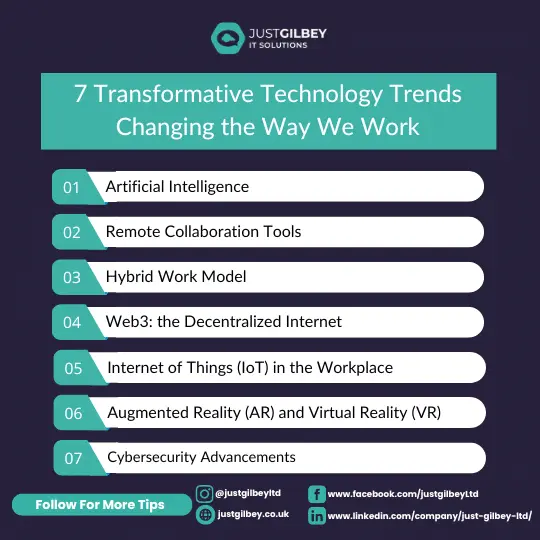
1. Artificial intelligence: now ordinary
AI went from novelty to normal. Copilot Chat now comes with Microsoft 365 Business Basic, Standard and Premium, according to Microsoft UK. The government’s Cyber Security Breaches Survey 2025/2026 found 31% of UK businesses were using AI, adopting it or actively considering it, but only 24% of those had security practices in place to manage the risks.
What matters now: clear rules and tidy permissions, not more tools. See our posts on everyday AI rules for staff and what Microsoft 365 Copilot actually does.
2. Remote collaboration tools: settled
Teams, shared files and video calls are simply how offices work now. There’s little new to buy. The work is keeping them secure: multi-factor authentication, sensible sharing settings and controlling guest access.
3. Hybrid working: here to stay
The ONS found that 28% of working adults in Great Britain hybrid worked between January and March 2025, a proportion that has gradually risen since 2022.
What matters now: laptops that are managed, encrypted and kept up to date wherever they are, and sign-ins that are protected however people connect.
4. Web3: not for the typical office
Blockchain, NFTs and decentralised finance haven’t become part of everyday small business IT. Unless your work involves them directly, they don’t need a place in your IT plan.
5. Connected devices: now covered by law
Smart devices kept spreading, and the law caught up. Since 29 April 2024, the UK’s product security regime has required makers of consumer connectable products to stop using universal default passwords, publish how to report security problems, and say how long the product will get security updates.
What matters now: check that support period before you buy a camera, doorbell or smart TV for the office, and keep those devices on a separate network from your work computers.
6. Augmented and virtual reality: still niche
AR and VR have their uses in design and training, but for a solicitor’s, accountant’s or small office they’re not a priority.
7. Cyber security: the trend that never stops
The breaches survey found 43% of UK businesses identified a breach or attack in the previous 12 months, and phishing was by far the most common type, hitting 38%. The biggest change since 2024 is in how we sign in. In April 2026 the NCSC said passkeys should now be the first choice wherever they’re offered, because passwords lack resilience to modern threats. Our post on passkeys explains how they work.
What’s arrived since 2024
Windows 10 has reached the end of its life
Microsoft stopped supporting Windows 10 on 14 October 2025. Businesses can buy Extended Security Updates for up to three years, but the price doubles every year. It buys time; it isn’t a plan. Any PC that can’t run Windows 11 needs replacing.
Old phone lines switch off in January 2027
Openreach will retire the old copper telephone network (PSTN) on 31 January 2027, and has been raising prices for the remaining legacy lines through 2026. It’s not just phones. Openreach lists alarms, card payment terminals and CCTV among the equipment that can depend on the old network. If you still have an analogue line, move it now rather than in January. Our business phones page covers the cloud alternative.
Data protection law has changed
The Data (Use and Access) Act 2025 updated parts of UK data protection law, and the ICO is reviewing its AI and data protection guidance as a result. If you use AI with personal data, keep an eye on the updated guidance.
A 12-month checklist
- Agree your AI rules and tidy Microsoft 365 permissions before buying Copilot.
- Replace or upgrade any remaining Windows 10 PCs.
- Find every analogue line and device, and move them before 31 January 2027.
- Turn on multi-factor authentication everywhere, and passkeys where you can.
- Check connected devices get security updates, and keep them off your main network.
From our work
We’ve moved several clients off Windows 10 ahead of the end of support. One request came from a local dental practice worried about Windows 10 and Windows Server 2016 reaching end of life. When we looked, the problems went further: their licensing wasn’t correct, the server was ten years old, and nobody was looking after their IT. As a dental practice, they also have NHS compliance to meet, so out-of-date systems were a compliance risk as well as a security one.
David Gilbey, Just Gilbey IT Solutions
Windows Server 2016 reaches the end of Microsoft’s extended support in January 2027, and practices that treat NHS patients publish an assessment against the NHS’s data security standards through the Data Security and Protection Toolkit.
Our IT consulting service turns changes like these into a practical plan and budget for your company, so you deal with them on your timetable rather than in a rush.
Questions people ask
When do UK analogue phone lines switch off?
Openreach says the old copper telephone network (PSTN) will be retired on 31 January 2027. Anything still using it, such as some alarms, card payment terminals and CCTV, needs to move to a digital service before then.
Can we keep using Windows 10?
Microsoft stopped supporting Windows 10 on 14 October 2025. Businesses can pay for Extended Security Updates for up to three years, but the price doubles each year, so it’s a stopgap while you move to Windows 11.
Do we need to do anything about the metaverse or Web3?
For most small businesses, no. They haven’t become part of everyday office IT. Spend the time and budget on security, Microsoft 365 and the phone line switch-off instead.
Sources
- Microsoft Learn: Windows Server 2016 lifecycle (extended support ends January 2027)
- NHS England: Data Security and Protection Toolkit
- GOV.UK: Cyber security breaches survey 2025/2026 (30 April 2026)
- ONS: Who has access to hybrid work in Great Britain? (11 June 2025)
- GOV.UK: The UK Product Security and Telecommunications Infrastructure (Product Security) regime
- NCSC: Leave passwords in the past, passkeys are the future (23 April 2026)
- Microsoft Learn: Extended Security Updates (ESU) programme for Windows 10
- Openreach: Time for a big switch up as PSTN switch-off looms (5 February 2026)
- Microsoft UK: Compare all Microsoft 365 business plans
- ICO: Guidance on AI and data protection (under review)